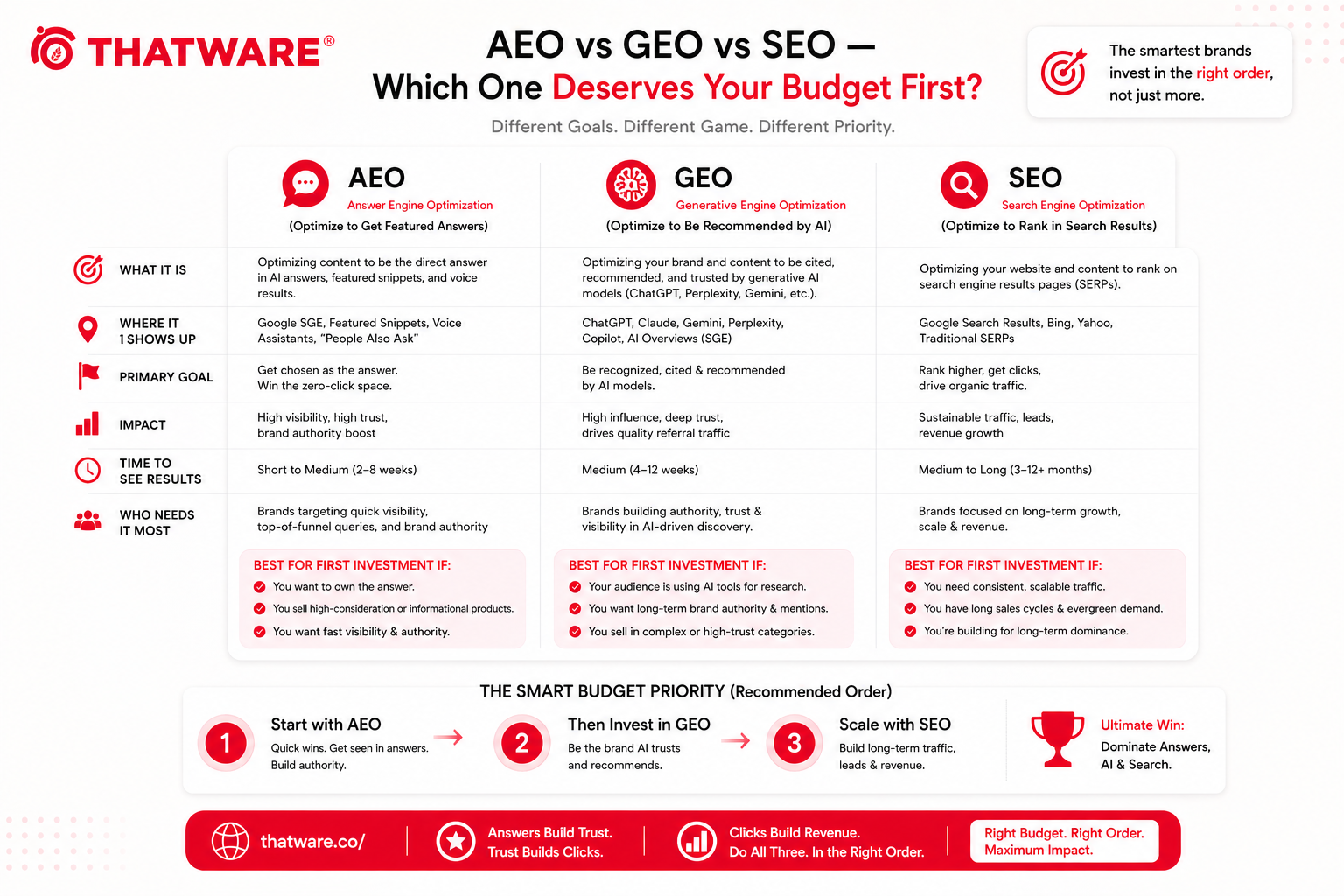
Three disciplines, all acronymed, all competing for the same marketing budget, all claiming to address critical aspects of modern search visibility. SEO you’ve probably been doing for years. GEO (Generative Engine Optimization) and AEO (Answer Engine Optimization) are newer, and the vendors selling them would each like you to believe theirs is the most urgent investment.
Here’s an honest framework for thinking about how to sequence these investments – not as a vendor trying to sell you a specific service, but as a genuine attempt to help you allocate limited resources where they’ll produce the most impact for your specific situation.
The short answer, which I’ll spend the rest of this article qualifying properly: start with SEO fundamentals, layer AEO as a natural extension, and add GEO as your authority base matures. But the right sequence for your specific situation depends on factors worth examining.
What Each Discipline Actually Does
Let’s make sure we’re comparing clearly, because the terminology is genuinely confusing.
Traditional SEO is the full range of work that improves visibility in traditional search results – technical optimization, content strategy, link building, local SEO. It’s still producing real traffic. It’s still a primary channel for most brands. It’s not going away, it’s evolving.
AEO – Answer Engine Optimization – focuses specifically on optimizing for featured snippets, People Also Ask placements, knowledge panels, and voice search results. It’s essentially traditional SEO with additional emphasis on direct-answer formatting, schema markup, and the structured content that earns answer-box placements. For most brands, AEO is a layer on top of solid SEO, not a replacement for it.
GEO – Generative Engine Optimization – focuses on visibility in AI-generated search results: ChatGPT, Perplexity, Google’s AI Overviews, and similar systems. It requires brand authority and content characteristics that make AI systems comfortable citing you, and it operates on different mechanisms than traditional ranking signals.
The key observation: these disciplines aren’t actually competing with each other. They’re addressing different surfaces within a broader search ecosystem, and they share a large foundational base.
The Shared Foundation That Makes All Three Work
Here’s what most discussions of AEO vs. GEO vs. SEO underemphasize: the foundation that powers all three is substantially the same. Genuine topical authority. Content that answers questions comprehensively and accurately. Clean technical infrastructure. A brand entity that’s clearly and consistently defined. Trustworthiness signals across multiple independent sources.
A brand that builds this foundation gets benefits across all three disciplines simultaneously. Their well-structured, comprehensive content wins featured snippets (AEO). Their topical authority helps them rank in traditional results (SEO). Their credibility signals make them attractive to AI citation (GEO). The foundation is the same investment producing three different returns.
This means that for most brands, the right first question isn’t “which discipline should I invest in?” It’s “how strong is my foundation, and where are the gaps?” Weak foundation → build it, and all three disciplines benefit. Strong foundation with specific gaps → invest in the discipline that addresses those specific gaps.
When to Prioritize AEO
Aeo services make the most sense as a near-term priority in a few specific situations.
You’re already ranking in positions 1-10 for important queries but not capturing featured snippets. AEO tactics – direct answer sections, FAQ schema, structured content – can convert existing rankings into answer-box placements that increase click-through rate without requiring new authority building.
Your audience is heavily voice-search-oriented. Certain demographics, industries, and query types skew heavily toward voice search. If your audience is asking questions to devices rather than typing them into browsers, AEO’s focus on voice-optimized answer formats is more urgent.
You’re in a category where AI Overviews are already appearing frequently for your priority queries. AEO-optimized content is the same content that tends to appear in AI Overviews – the overlap between these disciplines is very high.
When to Prioritize GEO
Aeo based agency and GEO priorities often arrive together, but GEO specifically warrants priority when:
You’re in a high-consideration category where buyers use AI tools for research before making decisions. B2B software, financial services, professional services, complex consumer products – these categories see heavy AI-assisted research. Brands not appearing in AI research answers are invisible to a significant portion of their audience during the most influential part of the buying journey.
Your brand is absent from AI answers for queries where you should naturally appear. If someone asks ChatGPT about the best options in your product category and you’re not mentioned, that’s a GEO gap with direct impact on brand consideration.
Your competitors are appearing in AI answers and you’re not. Competitive AI search presence is both a visibility gap and a positioning problem – being absent while competitors are cited creates an authority differential that compounds over time.
The Budget Sequencing That Makes Sense
For most brands, a practical sequencing:
Phase 1 (foundation): Technical SEO health, topical content architecture, entity definition across the web. This is traditional SEO work, but it’s also the foundation for AEO and GEO. Not optional, not separable.
Phase 2 (AEO layer): Direct answer optimization for existing content, FAQ and structured schema implementation, featured snippet targeting for queries where you already have ranking traction. Relatively low-cost additions to ongoing SEO work.
Phase 3 (GEO build): Off-site authority development for AI systems – media relations for expert citation, Wikipedia/Wikidata presence, content credibility signals. More investment-intensive, longer horizon, highest long-term compounding return.
The brands that have the most comprehensive search visibility in 2026 – across traditional rankings, answer placements, and AI citations – are the ones who started building the foundation early and layered each discipline as their authority base matured. Sequential, compounding investment rather than trying to do everything at once or picking one to the exclusion of others.